


Washington, D.C. – The battle over birthright citizenship has finally wound up before the nine Justices of the U.S. Supreme Court. In what could be one of the most significant cases of the 21st century, affecting life in the 50 States and the U.S. Territories, the highest Court in the Land will hear the argument whether President Donald Trump, by Executive Order (EO), has the right to end birthright citizenship as it is now implemented, and if that EO complies with the 14th Amendment of the U.S. Constitution.


In the simplest of terms, the Court will look at whether someone born on U.S. soil automatically becomes a citizen of the United States irrespective of their parents status.
Given the fact that courts throughout the country have routinely upheld the current interpretation of birthright citizenship for over one-hundred years, it would seem the Trump Administration faces an uphill battle. But given the conservative political make-up of the current Supreme Court, their upcoming ruling is anything but certain.
The Fourteenth Amendment, Section 1 of the Constitution states: “All persons born or naturalized in the United States, and subject to the jurisdiction thereof, are citizens of the United States and the State wherein they reside.”
The Fourteenth Amendment was ratified in 1868 in response to the end of the Civil War, and the 1857 Dred Scott decision – which concluded that enslaved people (and their children) were not American citizens and thus had no rights, despite their birth in U.S. States and Territories, including they could not sue in federal court, along with other restrictions that are afforded to citizens in the 50 States.
The Immigration and Nationality Act of 1952 mirrors the language of the 14th Amendment – that a citizen is someone who is born in the United States and subject to the jurisdiction thereof.
There are basically two forms of birthright citizenship: Ancestry-based citizenship and birthplace-based citizenship. Birthplace-based citizenship grants citizenship based on place of birth, it is formally referred to as Jus soli, a Latin term meaning “right of the soil.” which has always been guaranteed by the 14th Amendment. This principle was confirmed by the 1898 Supreme Court case United States v. Wong Kim Ark, which clarified that children born in the U.S. to immigrant parents are citizens, regardless of their parents’ immigration status.
Ancestry-based citizenship extends citizenship to children born abroad to U.S. citizens, provided statutory requirements are met.
Globally, birthright citizenship is common in the Americas but not instituted in many other regions.
Ahead of the Supreme Court reviewing the case (Trump v. Barbara) starting on April 1, 2026, whether an EO can narrow the definition of constitutional birthright citizenship, President Trump once again ripped at the entire substance behind the controversial issue.
“Birthright Citizenship is not about rich people from China, and the rest of the World, who want their children, and hundreds of thousands more, FOR PAY, to ridiculously become citizens of the United States of America. It is about the BABIES OF SLAVES!” Trump wrote on Truth Social. “We are the only country in the World that dignifies this subject with even discussion. Look at the dates of this long ago legislation – THE EXACT END OF THE CIVIL WAR!” he added.
It is believed that the arguments before the Supreme Court will weigh heavily on the words: “subject to the jurisdiction.”
Trump and the Department of Justice (DOJ) are arguing that only the children of citizens and permanent legal residents are “subject to the jurisdiction” of the U.S., not immigrants living in the country without legal permission, or temporary visitors.
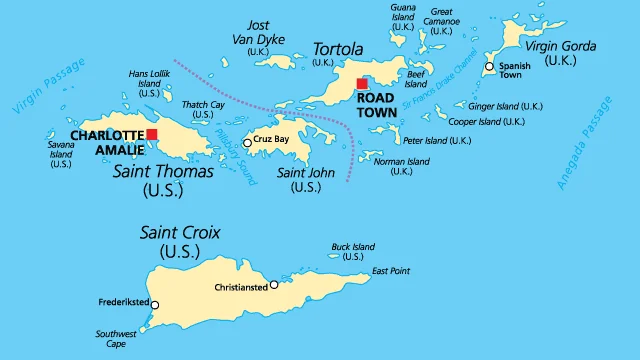
The argument hits at the heart of many issues involving the USVI and the other Territories.
“Over the last 125 years, the Supreme Court has avoided answering whether people born under the sovereignty and jurisdiction of the United States have a right to be recognized as U.S. Citizens under the Fourteenth Amendment,” states Neil Ware, Co-Director of Right to Democracy, a nonprofit focused on issues of democracy, equity, and self-determination, who is considered by many to be a champion for the rights of the Territories, and who served as Counsel of Record for the brief. “This troubling experience offers a stark object lesson for the Justices as they consider whether to allow the Trump Administration to alter the long-settled meaning of the Citizenship Clause.”
Under the present interpretation of the 14th Amendment, the U.S. Virgin Islands and the other major Territories do not have the right to vote for President of the U.S. and are consistently stripped of other rights which are afforded to the Upper 50 States
“This is a question about the exercise of power under the U.S. Constitution – can the President or Congress simply decide to exclude groups of people they do not want to be considered U.S. citizens?” said Adi Martinez Romain, Co-Director of Right to Democracy. “The U.S. Constitution regulates the power of government and protects its subjects from abuse. Therefore, the Supreme Court’s consistent avoidance of this issue in U.S. Territories has created uncertainty and confusion when it comes to our own questions of self-determination and decolonization.”
The root question before the Supreme Court is whether President Trump’s Executive Order on birthright citizenship violates the Citizenship Clause of the 14th Amendment and a provision of federal law that codified that clause. That statute was first enacted through the Nationality Act in 1940 and then reenacted in the Immigration and Nationality Act in 1952.
The interplay between the Revised Organic Act of 1954 (which is the fundamental law and functional constitution of the U.S. Virgin Islands), and the 14th Amendment brings into full focus the outcome of the question before the Supreme Court as to whether Congress will continue to grant citizenship to a certain status of people born in the U.S. Territories.






Leave a Reply