


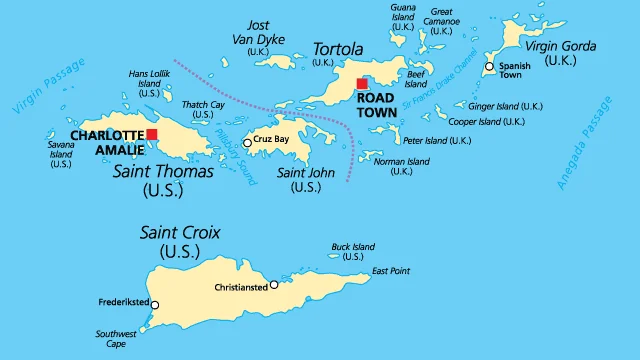
The socio-economic idea of a Greater Virgin Islands remains a powerful conceptualization of the mutual desire for shared prosperity across the archipelago. Not only does the term represent the collective group of islands that geographically make up most of the island chain, but it also captures the special relationship between the British Virgin Islands (BVI) and United States Virgin Islands (USVI) that are tied together by a shared history, interdependent economies, and kinship.


At the heart of the special relationship are the enduring bonds between the people of the BVI and USVI who share a common Virgin Islands culture based on their unique English creole, music and food; and whose longstanding family ties cut across the islands.
The ancestral Virgin Islanders of both Territories largely view themselves as one people who have historically relied upon each other for nearly two centuries for their survival and advancement. In recognition of this, the respective citizens of the BVI and USVI have visa free access for ease of travel between the two Territories. Moreover, many Virgin Islanders on both sides of the archipelago enjoy some form of immigration status in both jurisdictions by virtue of their family roots.
The special relationship between the BVI and USVI is also underpinned by their economic interdependence. The USVI is a key transportation hub for the BVI through which thousands of US tourists transit to get to the BVI for vacation. This access remains critical to the Territory’s tourism sector. Conversely, the BVI’s tourism sites are vital tourist attractions for USVI tour operators in St. Thomas and St. John who routinely organize sailing excursions for their clients to the Baths on Virgin Gorda and White Bay on Jost Van Dyke.
Inter-Virgin Islands trade and commerce is another important pillar of the Territories’ economic interdependence. BVI merchants and consumers form a significant customer base for USVI businesses which helps to drive the USVI economy. Both Territories are also served by shipping companies, charter boat companies, ferry companies, water taxis and other businesses that operate across both jurisdictions.
In the media, culture and entertainment sectors, the BVI and USVI essentially constitute one market. The annual St. Thomas Carnival in April/May, BVI Emancipation Festival in July/August, and other festivals, fairs and concerts held on the various islands of the Territories, provide local entertainment, leisure, and cultural attractions for people across the Greater Virgin Islands.
However, to stimulate greater economic growth and development from which both the BVI and USVI can benefit, their shared economic spaces must be broadened where possible to create a bigger market in which businesses, consumers, investors and entrepreneurs can operate and thrive.
Areas such as agriculture, research, arts, sports, and the creative and cultural industries can benefit from the economies of scale the Greater Virgin Islands market provides. Combined marketplaces in these sectors can generate more opportunities than the individual markets of each Territory.
While the BVI and USVI will remain two separate jurisdictions with distinct political systems, they stand a much better chance of a brighter future through shared prosperity.
This remains the objective of the Inter-Virgin Islands Council (IVIC) established by the Governments of the two Territories over twenty years ago.
By working together, the BVI and USVI can unlock the full potential of the Greater Virgin Islands from which both societies can prosper well into the future.




Leave a Reply