


“The best way to predict the future is to create it” – Peter Drucker
The year is 1997. I was a junior in high school. I still remember taking a taxi across the island with my good friends Easst and Lamar to grab an outfit for the Jr. Gong (Damian Marley) concert. We headed to Christiansted, which at the time felt like our own Fifth Avenue. The streets buzzed, the shops were alive, and even with just a hundred dollars in our pockets, we felt like we were rich.


Christiansted was thriving back then. The streets were full, the boardwalk buzzed, and the shops were more than just stores — they were proof that opportunity lived here. We grabbed a slice at Pizza Mare, browsed the racks at Caribbean Clothing, and bought a pair of shades at the Sunglass Hut. For us teenagers, it wasn’t just about the clothes or the food; it was about coming of age and ‘bussin’ a lime’ in a town that felt full of energy and possibility.
But today, Christiansted is no longer a bustling seaside town. Day or night, the energy is gone. Businesses are shuttered, foot traffic is sparse, and the sense of possibility has vanished. The vibrancy that once defined Christiansted has given way to stagnation and decline. And Christiansted is not alone. Across the Virgin Islands, what was once a story of growth has become a story of exodus.

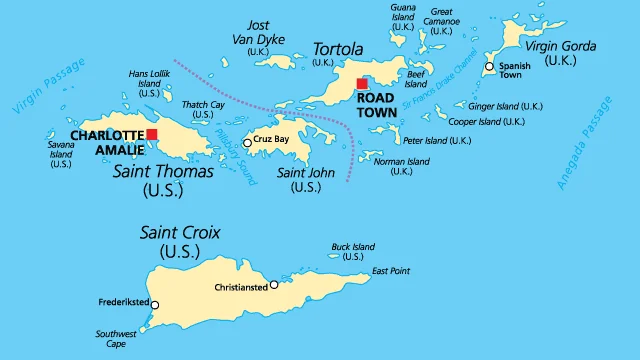
According to the 2020 Census, the population of the Virgin Islands decreased to 87,146 — a nearly 20% decline from 2010. Each of our islands has seen a significant decline:
• St. Croix: down from ~50,600 residents in 2010 to 41,004 in 2020 (-19%).
• St. Thomas: down from ~51,600 in 2010 to 42,261 in 2020 (-18%).
• St. John: down from ~4,170 in 2010 to 3,881 in 2020 (-7%).
From 1960 to 1970, the U.S. Virgin Islands experienced a remarkable boom — in just one decade, our population doubled from ~30,000 to ~60,000 residents. The growth continued into the next decade, with another 30,000 people added between 1970 and 1980. By 2000, the territory reached its peak population (108,612). But since then, the trend has reversed. Each census since 2000 has shown a decline, with thousands of Virgin Islanders leaving in search of opportunity elsewhere. The question now is stark: will the Virgin Islands shrink back to a population of just 30,000? Without a catalyst to spark growth, it’s more likely than not.

History Repeating Itself
The truth is, none of this is new. On December 21, 1984, The New York Times ran a story titled “U.S. Virgin Islands in Economic Slump.” The article described a government struggling to meet payroll, a slumping industrial base on St. Croix, and a tourism sector that native Virgin Islanders often shunned because they saw little upward mobility in it.
At the time, Hess Oil was embroiled in a labor dispute, the Martin Marietta bauxite plant was in decline, and government jobs had expanded to employ more than one out of every three working-age residents. The paper warned that while winter tourism numbers looked strong, the lack of trained local managers, the disdain for service jobs, and the decline of manufacturing were putting the entire economy at risk.
Nick Pourzal, then the general manager of Frenchman’s Reef Hotel, put it bluntly: Virgin Islanders, he said, were “like a spoiled kid who likes to spend Daddy’s money but doesn’t care where it comes from.” His point was that we could not ignore the tourism sector. However, the bigger truth is this: even then, our economy was overly reliant on tourism and government jobs, both of which offered limited long-term prospects for growth. Hotels may be important, but non-hotel industries — such as manufacturing, technology, and professional services — generate far more, high-paying, sustainable jobs.
Forty years later, how much has really changed? Tourism still dominates more than half of our economy. Government remains the largest employer. Industrial anchors like HOVENSA and VIALCO have vanished. And our young people are still leaving, convinced their best opportunities are elsewhere.
Lessons from Detroit and Cleveland
This challenge is not unique to us. Across the United States, numerous industrial cities once faced similar crises.
• Detroit was once the proud capital of auto manufacturing. As the industry collapsed, so did the City’s population — from 1.8 million in the 1950s to barely 600,000 today. Yet in 2023, Detroit’s population grew for the first time in decades, adding nearly 7,000 residents. The City is reinventing itself through technology startups, healthcare investments, and the adaptive reuse of old industrial spaces.
• Cleveland became a symbol of decline in the 1970s after losing its manufacturing core. But it stabilized by investing in “eds and meds” — universities and healthcare. Today, healthcare is the region’s largest employer, supporting over 270,000 workers, with the Cleveland Clinic’s 82,000 caregivers and 23 hospitals at its core.
The lesson for the Virgin Islands is clear: we cannot cling to past industries. We must invest in sectors that will sustain us in the 21st century, such as light manufacturing, renewable energy, digital services, healthcare, and marine sciences. As the saying goes, “Companies that don’t innovate die. Economies are no different.” The Virgin Islands must stop relying on yesterday’s models and start building for tomorrow.
The Missing Ingredient: Private Investment
In the Virgin Islands, almost every major project you hear about comes from government or federal dollars. Whether it’s the $150 million GARVEE bond deal for roads, the $137 million “Rebuild USVI” contract, or the $100 million federal investment in WAPA’s fuel storage — these are all public funds. Our economy has become overly dependent on Washington and disaster aid to move forward.
That is not sustainable. Federal recovery money will dry up. Without private capital, we cannot build the kind of growth that multiplies new firms, jobs, supply chains, and opportunities for young Virgin Islanders.
Contrast private investment in the Virgin Islands with the wider Caribbean:
• In the Dominican Republic, more than $700 million in renewable energy projects were launched in a single year — funded by private investors betting on that market’s future.
• In Trinidad & Tobago, Shell is pouring billions into the Manatee natural gas project, anchoring long-term jobs and exports.
• In Turks & Caicos, steady inflows of private money into high-end resorts and real estate are not only reshaping the economy but helping the islands grow their population.
• Even in small islands like Nevis, the Four Seasons resort is expanding with 58 luxury residences built entirely with private capital, tied to citizenship-by-investment programs.
Detroit and Cleveland faced a similar challenge when their old industries collapsed. For years, they relied heavily on government aid and stopgap programs to keep afloat. However, the real turnaround only began when they created the conditions to attract private capital again — notably, tech firms in Detroit, healthcare, and universities in Cleveland. That shift is what stabilized their populations and rebuilt their economies.
The Way Forward
If Detroit and Cleveland can claw their way back, so can we. But it requires bold decisions and innovative leadership. It is imperative that we:
• Fix Energy – We cannot build lasting prosperity while burdened with some of the highest energy costs in the world. Affordable, dependable power is not a luxury — it is the bedrock upon which every thriving economy stands.
• Grow and Diversify the Private Sector – Incentivize professional service firms, light manufacturing, tech companies, and maritime industries to establish a permanent presence and hire locally.
• Reform Taxes – Replace the regressive gross receipts tax with a fairer, growth-oriented system.
• Invest in People – Build strong public transportation, support entrepreneurs, and expand workforce development programs.
• Attract Private Capital – Create a climate that welcomes foreign and local investment, not one that scares it away.
• Streamline Business Onboarding: Cut red tape and create a single, user-friendly portal that allows businesses to register, license, and launch their businesses quickly, making the Virgin Islands one of the easiest places in the Caribbean to start and grow a company.
Closing
Population decline isn’t just a statistic — it means families split apart, the slow fading of our culture, and young Virgin Islanders leaving the islands they love because they see no future here. It means that the next generation of leaders will choose to build their lives elsewhere, leaving our community weaker with each departure.
Consider this: while the overall unemployment rate hovers around 3%, youth unemployment in the Virgin Islands is over 25%. That means one in four young people cannot find work here. Faced with that reality, is it any surprise they leave?
The great Jamaican philosopher Mark Myrie — better known as Buju Banton — once sang:
“Who can afford to run will run.
But what about those who can’t?
They will have to stay.
Opportunity a scarce, scarce commodity.”
That is the cruel truth of the current Virgin Islands economy. Those with means, education, or opportunity leave; those without are left behind, struggling in a system that offers fewer chances to thrive. If we want to reverse this exodus, we must create an economy that doesn’t force people to choose between leaving and staying behind with less.
We must develop opportunities in abundance here at home. In other words, tourism cannot be our sole mate.







Leave a Reply